| CAMPBELL MARKET REPORT |
OCTOBER 2026 |

Alford-Bon | Tim & Faye | Sell · Buy · Invest
| |
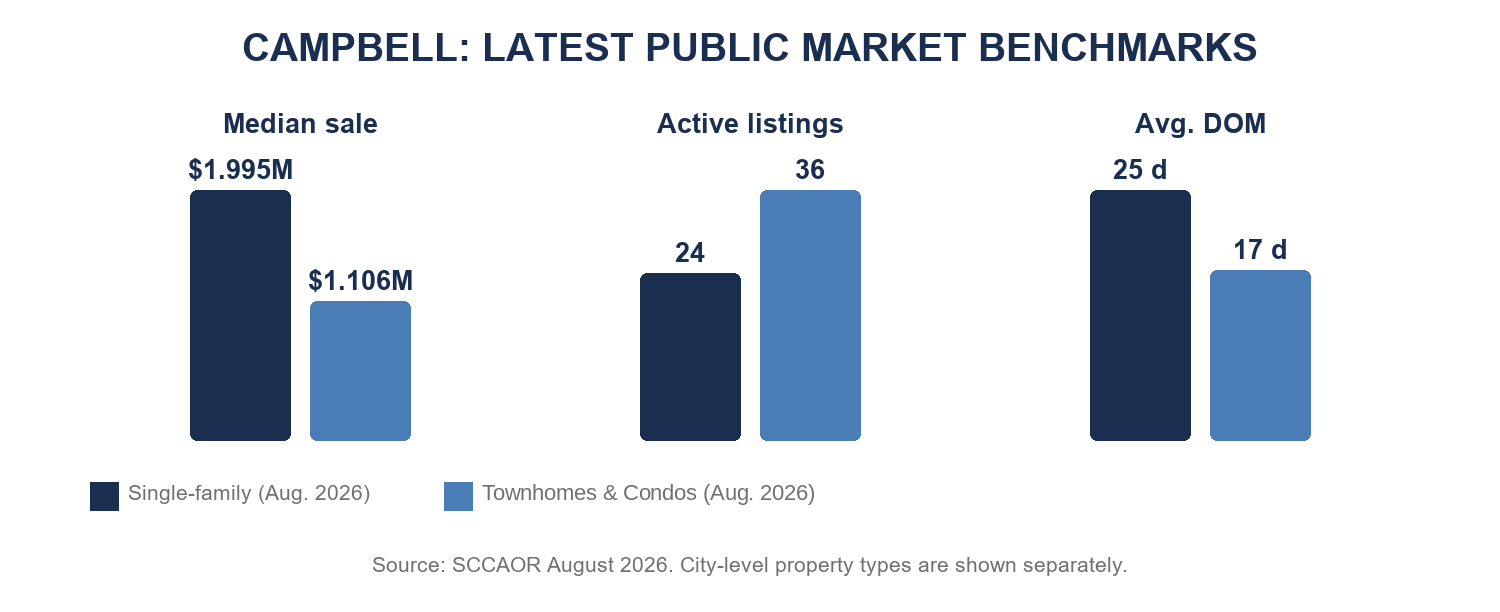
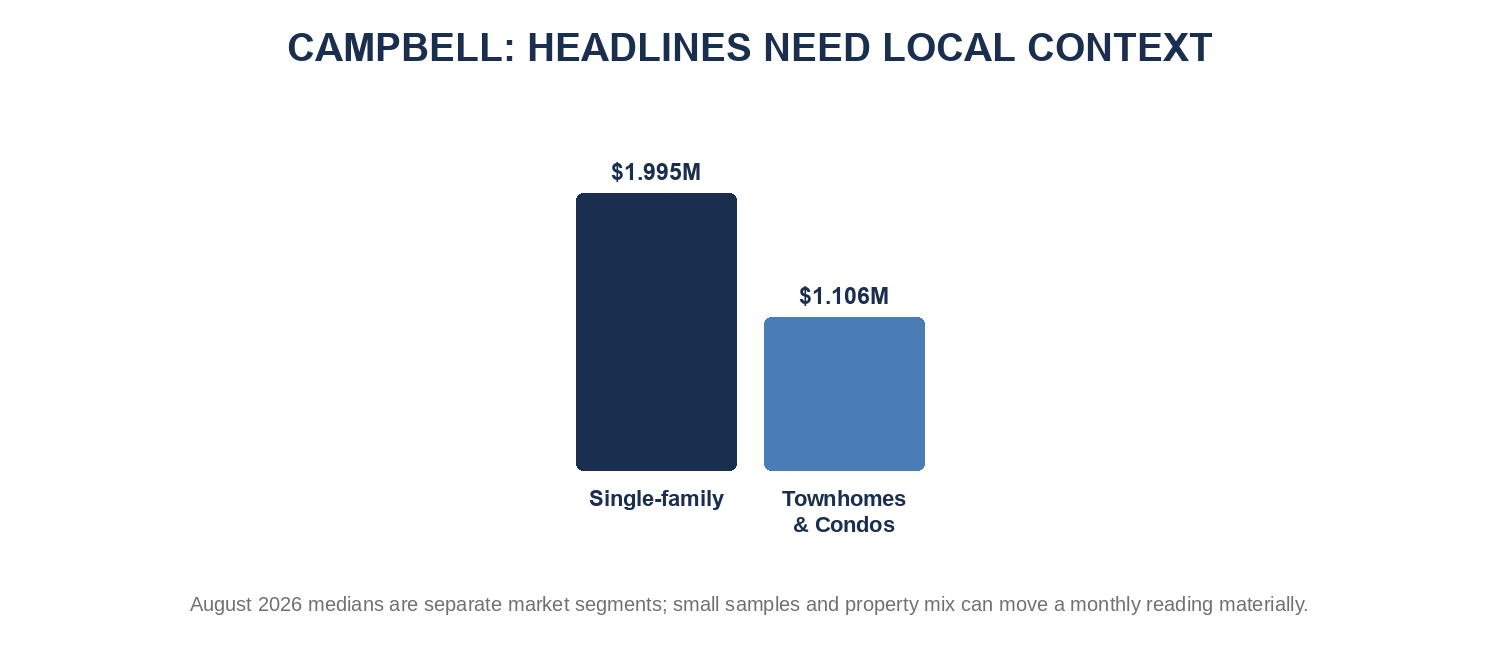
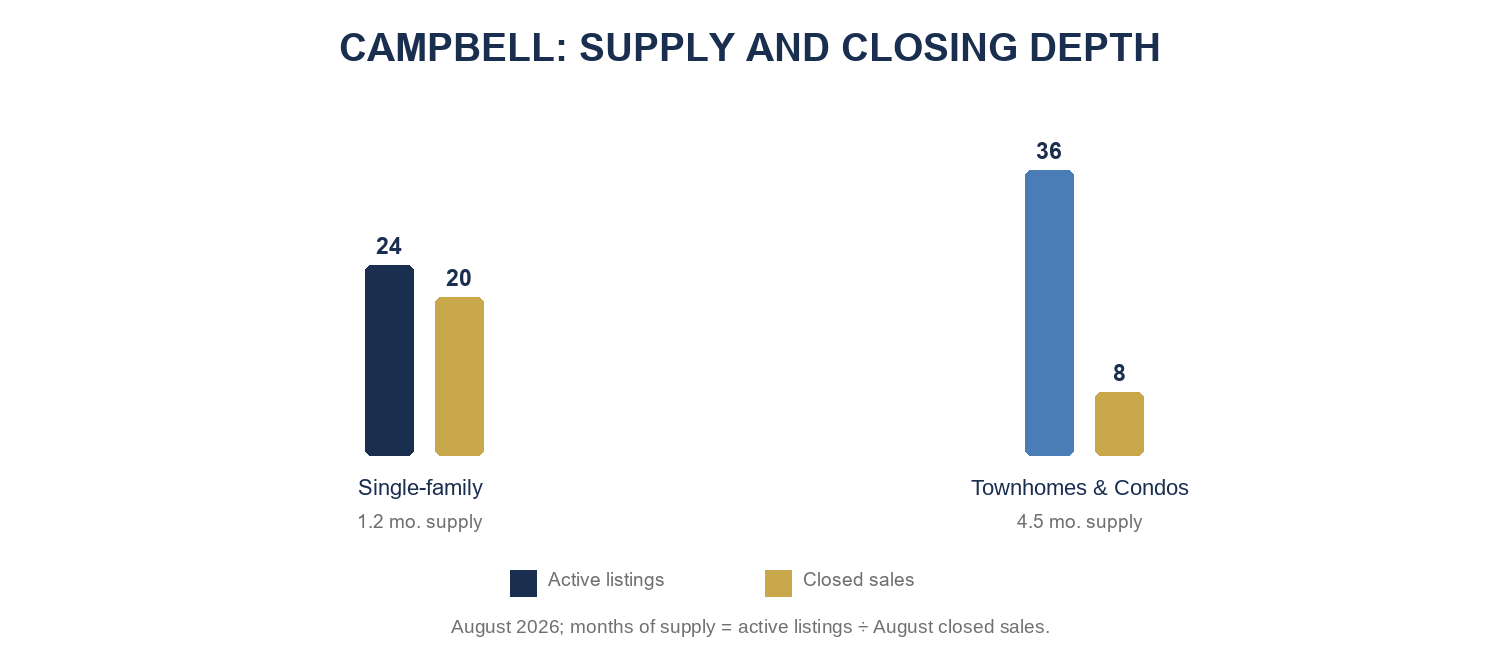
What changed since last month: financing tightened again, while Campbell's two-speed market—competitive single-family homes and more negotiable townhomes and condos—remained intact. Single-family homes recorded a $1.995M median across 20 closings, 101% of list price, and 25 average days on market. Townhomes and condos recorded a $1.106M median across 8 closings, 103% of list, and 17 average days.
From July to August, the first segment's median changed -17.2% and the second changed -7.8%. Those are month-to-month changes in the homes that happened to close, not an appreciation measure. The practical signal is the relationship among price, pace, list-price performance, and available alternatives. A polished home priced to match recent nearby sales can still attract several buyers quickly. A nearby home may sit longer when its condition, setting, disclosures, or asking price compares poorly with other available homes.
What this means:
- Homeowners and sellers: Compare single-family homes separately from townhomes and condos, then narrow the comparison by neighborhood, school area, condition, street, and proximity to downtown or major roads.
- Buyers: Townhomes and condos had 4.5 months of inventory, but eight closings still averaged 103% of list. Compare the home with nearby competitors, watch for a price change, missed offer date, or return to market, and confirm the seller's timing before seeking price or terms.
- Tim & Faye
|
|
|
Campbell Market
The Local Pulse
|
|
August 2026 at a glance
- Primary benchmark: Single-family: $1.995M median; 20 closings; 25 average days; 101% sale-to-list; 1.2 months of inventory.
- Comparison signal: Townhomes and condos: $1.106M median; 8 closings; 17 average days; 103% sale-to-list; 4.5 months of inventory.
- Selection and pace: Sample and selection: 28 closings across the shown market segments and 60 active listings; medians can be distorted when only a few homes sold or the mix of homes changed.
- Financing: the national 30-year fixed average was 7.28% on October 1. At that rate, 20% down on the $1.995M benchmark implies roughly $10,920 per month in principal and interest before taxes, insurance, and other costs. Pricing can differ by loan and borrower.
|
|
Financing & Affordability
What the October Rate Picture Means
|
|
Freddie Mac's national 30-year fixed average was 7.28% on October 1. With 20% down on the $1.995M benchmark, the illustrative principal-and-interest payment is about $10,920 per month, before property tax, insurance or other obligations. This is a planning illustration rather than a loan quote; pricing, points and borrower profiles can differ materially. The Federal Reserve raised its target range by one-quarter point on September 16; mortgage rates do not move one-for-one with that policy rate, so buyers should compare the actual fixed-rate, adjustable-rate, and buydown quotes available for their loan size.
C.A.R.'s second-quarter affordability index found that 22% of Santa Clara County households could afford the county's $2.05 million median single-family home. Its model required about $510,800 in annual income at a 6.54% effective rate. Campbell's townhomes, conventional houses, and luxury or custom homes attract buyers with different budgets, down payments, and financing options; one regional employment headline cannot explain demand for all of them.
Many buyers are using adjustable-rate mortgages or temporary buydowns to reduce the initial payment while preserving the opportunity to refinance if fixed rates improve. That can be practical for a buyer with strong liquidity, expected income growth, or a defined holding period, but the adjustment schedule, rate caps, and future payment range should be compared with a fixed-rate option before offer day.
A targeted seller credit can sometimes address payment pressure more efficiently than a broad price reduction. Buyers should compare that benefit with the property's immediate repair, insurance, and ownership costs.
|
|
Market Behavior
What Is Moving
|
|
Entry-priced condo — 2871 South Bascom Avenue, No. 401. The one-bedroom, one-bath, 668-square-foot condo closed August 18 for $510,000. It shows a Campbell ownership entry point well below the single-family headline, but property type, HOA obligations, size, and condition remain essential to the comparison.
Near the single-family median — 1270 Hoffman Lane. The four-bedroom, two-bath, 1,700-square-foot home closed August 25 for $1.85 million, near August’s $1.995 million single-family median. It is a useful benchmark, not a substitute for comparing lot, condition, location, and immediate competition.
Upper-market sale — 1324 Bent Drive. The three-bedroom, two-and-one-half-bath, 2,225-square-foot home closed August 20 for $2.725 million. The result shows that larger, well-located Campbell homes can attract buyers with different budgets and priorities than a typical resale.
|
|
Market Behavior
Where Activity Stalls
|
|
Townhomes and condos that ignore the 4.5-month supply backdrop. With 36 active listings against eight August closings, buyers have time to compare and negotiate, particularly where dues, reserves, insurance, or assessments are unresolved.
Older houses with unpriced systems or permit questions. Buyers will accept work when it is quantified; vague roof, electrical, drainage, foundation, sewer, or addition risk narrows the pool.
Pricing from a Los Gatos or Saratoga comparable without matching the proposition. A nearby premium does not transfer automatically across jurisdiction, school assignment, lot, architecture, or walkability.
|
|
Regional Comparison
AI Wealth: Relevant, Not the Whole Story
|
|
Campbell can benefit from Silicon Valley technology and AI wealth, but its demand base is broader than the Peninsula's prestige market. Buyers are often balancing commute access, downtown lifestyle, schools, lot utility, and relative value against Los Gatos, Cambrian, Willow Glen, and West San Jose.
The likely AI effect is supportive rather than transformative: more purchasing power for the best single-family homes and remodeled properties, while townhomes, condos, and dated inventory remain governed by monthly cost and property-specific quality.
| |
Our read: Campbell's best single-family homes should remain competitive, while townhomes, condos and dated listings give buyers more room to compare and negotiate. |
|
|
What Changes Next
Local Community Watch
|
|
SB 79 is now an active local planning issue. The state law took effect July 1 and sets minimum housing standards near qualifying transit. Campbell identifies areas within one-half mile of the Hamilton, Downtown Campbell and Winchester light-rail stations, plus a limited Bascom area.
Campbell is defining how the law applies locally. The City adopted an interim ordinance addressing exclusions, historic resources and conflicts with local zoning, while approved and pending starter-home projects add smaller groups of two to ten homes.
Why residents should care. The near-term effect is more applications and planning review, not a sudden wave of resale inventory. Watch HCD review, the City's permanent rules and which projects reach permits and construction.
|
|
Six-Month Outlook
Our Base-Case View
|
| Segment |
Expected direction |
Why |
| Turnkey single-family homes |
Competitive |
Fast sales and sub-2-month supply. |
| West / central Campbell |
Firm |
Lifestyle and relative-value demand. |
| Dated single-family homes |
Selective |
Buyers price systems and permit risk. |
| Townhomes and condos |
Negotiable |
More choice and a much longer selling window. |
|
|
Prediction: Through early 2027, Campbell should remain a two-speed market. Well-prepared single-family homes are likely to stay competitive even if seasonal bidder counts ease. Townhomes and condos should provide buyers more leverage, while transit-area and small-scale housing policy changes shape long-term product mix rather than near-term resale supply.
This is a market outlook, not a guarantee of future value. Property condition, micro-location, school assignment, lot, architecture, insurance, and financing can materially change an individual result.
|
|
Recommendations
What Matters Now
|
|
For homeowners:
- Value houses separately from townhomes and condos, then narrow by neighborhood, school area, street, condition and downtown or road exposure.
- monitor SB 79 station-area rules and nearby starter-home applications when evaluating future use, privacy, parking, or redevelopment context.
- Keep the 1.2-month house market separate from 4.5-month townhome-and-condo supply; one Campbell trend cannot guide both pricing decisions.
For sellers:
- treat the first 10 to 14 days as the primary test for a single-family home and reset decisively if the target buyer does not respond.
- With 4.5 months of supply, a townhome or condo must show dues, reserves, insurance, assessments and parking before buyers compare it away.
- Near the Hamilton, Downtown Campbell or Winchester light-rail stations, disclose any known SB 79 or starter-home applications nearby so buyers are not surprised during escrow.
For buyers:
- With 1.2 months of house supply, pre-underwrite for the best homes but hold the offer to close neighborhood and condition matches.
- Use 4.5 months of townhome-and-condo supply to compare monthly cost, location and future competition before choosing price and terms.
- For an older house, budget for roof, electrical, sewer-lateral and permit questions before offer day; at 1.2 months of supply there is little time to investigate afterward.
|
|