MARKET REPORT

The Local Pulse
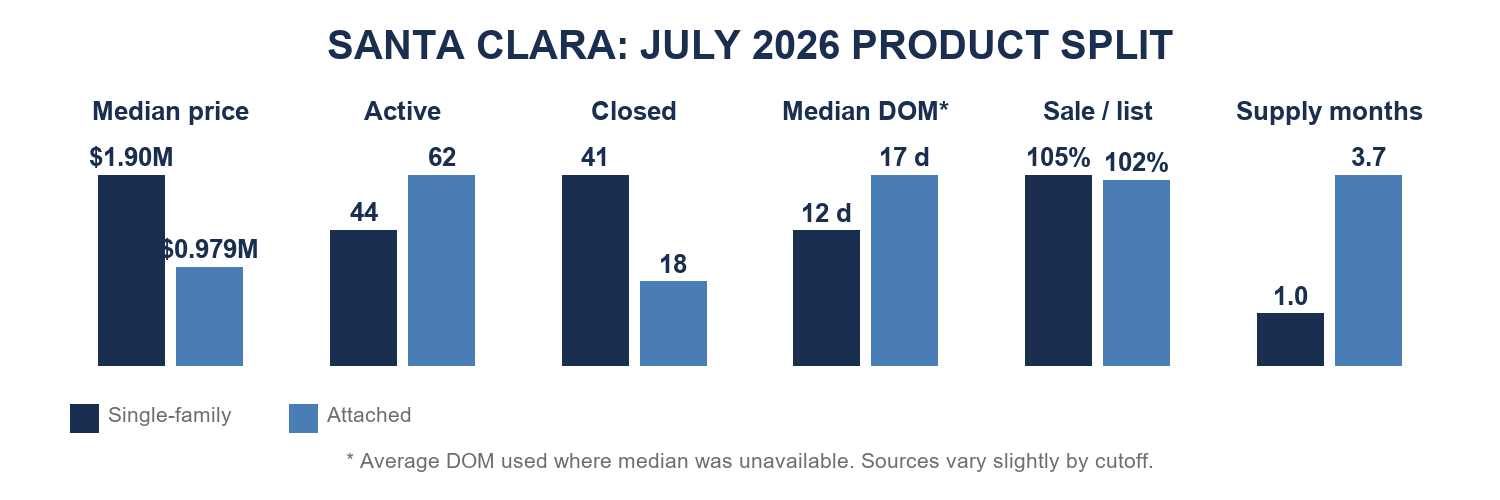
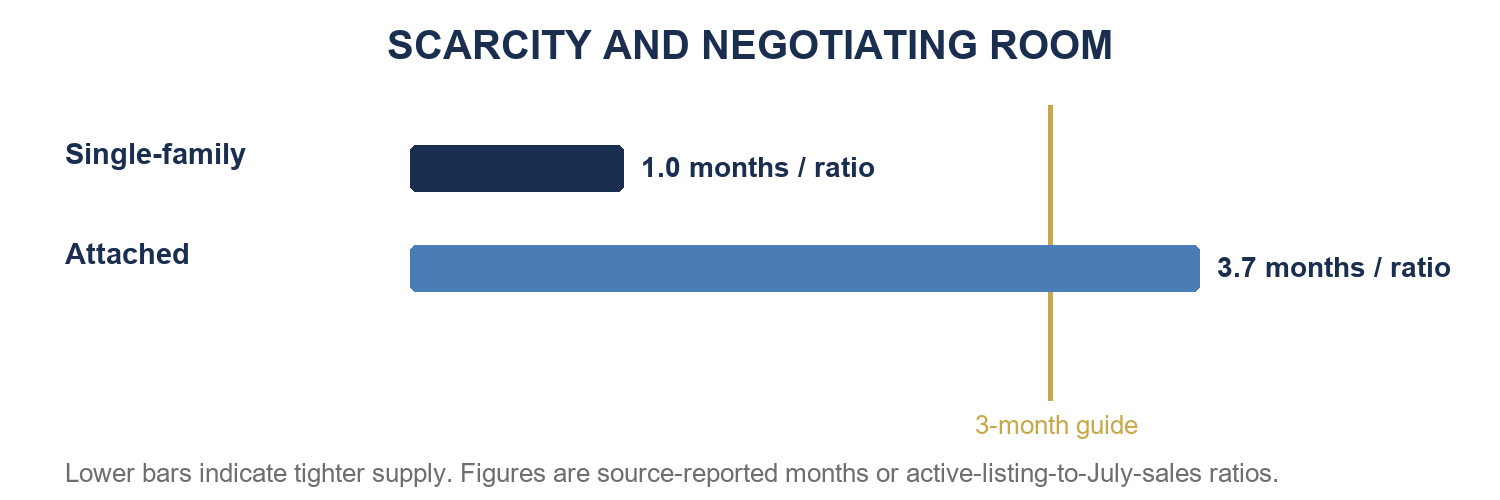
- July single-family median: $1.9M; 41 closings; 105% of list; 12 median days; 1.0 month of inventory.
- July attached median: $979K; 18 closings; 102% of list; 17 median days; 3.7 months of inventory.
- Q2 single-family median was also $1.9M, giving the July benchmark more credibility than a one-month spike.
- Source cutoffs differ slightly: SCCAOR counted 47/73 citywide active listings while Aculist showed 44/62; direction is consistent.
What the September Rate Picture Means
Freddie Mac's national 30-year fixed average was 6.71% on September 3. With 20% down on the city's July single-family median, the illustrative principal-and-interest payment is about $9,820 per month, before property tax, insurance, HOA costs or other obligations. This is a planning illustration rather than a loan quote; jumbo pricing, points and borrower profiles can differ materially.
C.A.R.'s second-quarter affordability index found that 22% of Santa Clara County households could afford the county's $2.05 million median single-family home. The model required about $510,800 in annual income at a 6.54% effective rate. That county measure is broader than any one city, but it explains why liquidity, equity and financing structure are now central to local demand.
Santa Clara gives payment-sensitive buyers more ways to adjust the product as well as the loan. A house may demand fast execution, while a condo or townhome can offer a lower purchase price and more negotiating room; HOA dues, reserves, insurance and assessments must be included before deciding which monthly payment is truly lower-risk.
Many buyers are using adjustable-rate mortgages or temporary buydowns to reduce the initial payment while preserving the opportunity to refinance if fixed rates improve. The practical test is whether the adjustment schedule, rate caps and future payment range fit the household's broader plan - not whether the market promises a particular refinance date.
What Is Moving
Single-family homes priced for immediate competition. One month of supply and 105% of list indicate that buyers still compress around clean, practical homes.
Neighborhoods with clear commute and utility value. Central location and Santa Clara's municipal services remain part of the ownership calculation, especially for buyers comparing nearby cities.
Attached homes with strong HOA fundamentals. The best units still sell, but buyers can distinguish sharply between well-run communities and buildings with insurance, reserve, or assessment concerns.
Where Activity Stalls
Attached homes that compete only on price. With 3.7 months of supply, generic presentation or unresolved HOA questions can quickly push a listing behind comparable choices.
Older homes with unpriced systems work. Buyers will absorb condition when the discount is credible; they resist vague electrical, roof, foundation, drainage, or permit exposure.
Overgeneralizing from the $1.9 million median. Santa Clara's ZIP codes and product ages differ. A 95050 house, a 95051 tract home, and a 95054 condo need separate peer groups.
AI Wealth: A Local Reading
Santa Clara is positioned as a relative-value alternative to Cupertino, Sunnyvale, and the Peninsula. AI and semiconductor investment can support employment confidence, but the first market effect is likely stronger demand for scarce single-family homes near major job centers.
The city is also creating substantial higher-density capacity. That can deepen the local amenities and housing base while keeping attached and rental supply more elastic than detached supply.
Forces to Watch
Tasman East. The adopted transit-oriented plan provides for thousands of homes, retail, parks, and public infrastructure; the city says current capacity is 5,403 units.
Patrick Henry Drive. The specific plan evaluates scenarios of roughly 10,300 to 12,000 homes in a future high-density mixed-use district.
El Camino and station planning. Continued corridor and station-area planning will concentrate most new supply away from established low-density neighborhoods.
Our Base-Case View
| Segment | Direction | Why |
|---|---|---|
| Single-family | Competitive | About one month of supply. |
| Best attached | Active | Good HOA and location still win. |
| Older attached | Negotiable | More choice and cost scrutiny. |
| New-density areas | Long-term change | Large pipeline, gradual delivery. |
Prediction: Single-family homes should remain the tightest segment through early 2027. Attached homes will be more price- and HOA-sensitive, giving buyers selective leverage. New specific-plan supply will influence expectations before it materially changes the resale inventory count.
This outlook is an informed opinion, not a guarantee. Property condition, micro-location, financing, schools, permits, insurance and broader economic conditions can materially change an individual result.
What Matters Now
- Homeowners: separate detached and attached comparables, then narrow by ZIP, age, and school boundary.
- Homeowners: monitor nearby specific-plan construction for both amenity gains and future product competition.
- Sellers: prepare disclosures and systems documentation early; single-family buyers move fast when uncertainty is low.
- Sellers: for attached homes, lead with reserves, insurance, assessments, parking, and HOA governance.
- Buyers: be ready to compete for turnkey houses but preserve inspection and financing discipline.
- Buyers: use the wider attached inventory to negotiate condition, closing terms, or price—after full HOA review.
Choose this city report to receive future local updates.
GET THE SANTA CLARA REPORT MONTHLY
Sources & Notes
- MLSListings / Aculist — Santa Clara
- City of Santa Clara — Tasman East fee/program page
- City of Santa Clara — Patrick Henry Drive Specific Plan
- City of Santa Clara — Specific Plans
- SCCAOR — July 2026 county and city statistics
- SCCAOR — Q2 2026 city statistics
- Freddie Mac — Primary Mortgage Market Survey
- WIRED — AI equity and Bay Area housing
- The Guardian — AI wealth and San Francisco housing
- C.A.R. — July 2026 California Home Sales and Price Report
- C.A.R. — Q2 2026 Housing Affordability Index
- BLS — San Jose-Sunnyvale-Santa Clara Economy at a Glance
- BLS — August 2026 Employment Situation
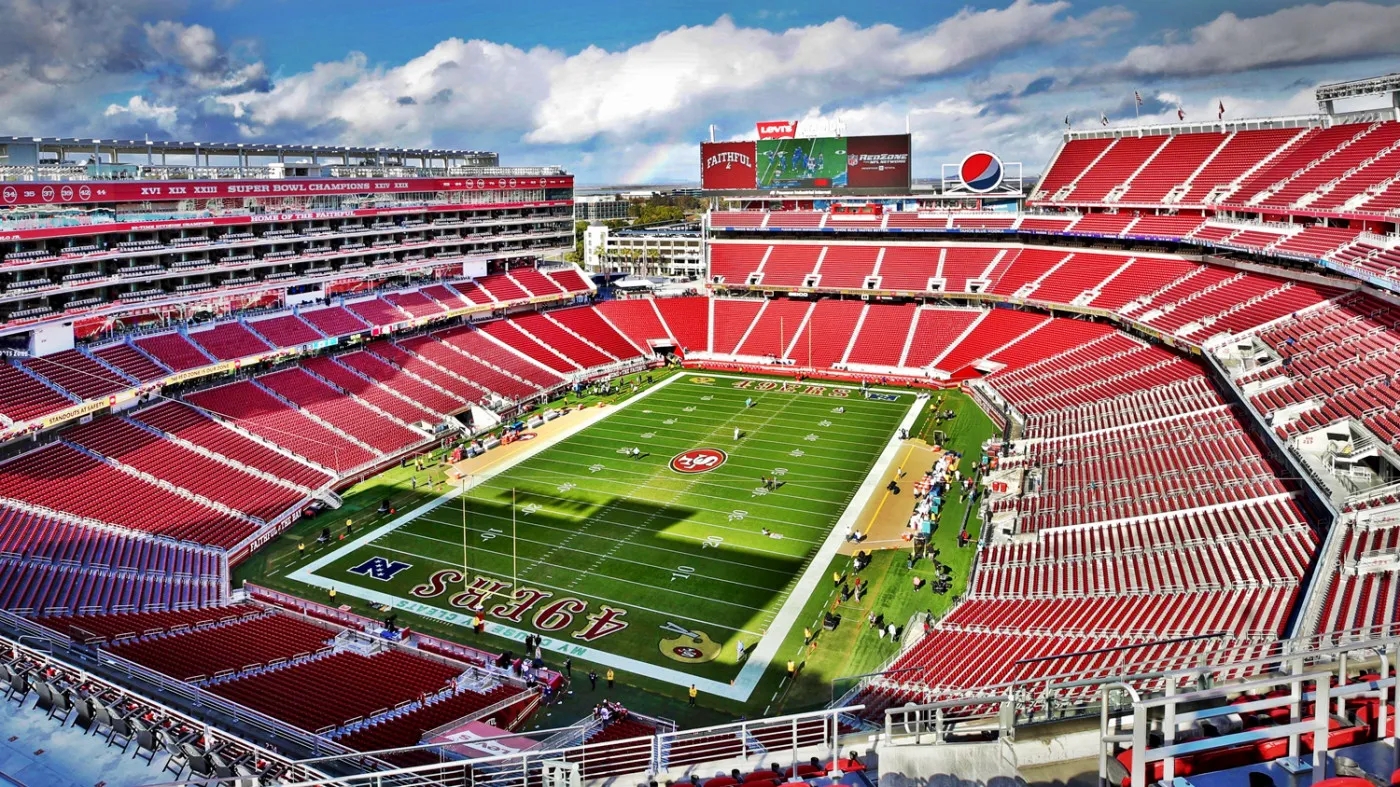
City market figures use July 2026 unless stated otherwise. SCCAOR had not published August 2026 city statistics as of September 5, so July remains the newest complete official city period for this edition. Source cutoffs and property classifications can differ. Hero photography was supplied by Tim Alford for use in this report.

Christie's International Real Estate Sereno
214 Saratoga-Los Gatos Rd, Los Gatos, CA 95030
(408) 832-7698 · homes@alfordbon.com
Alford-Bon Team Website
TIM ALFORD DRE #01507448 · FAYE BON DRE #01746037 · SERENO GROUP, INC. DRE #02101181

Santa Clara is a two-speed ownership market. July single-family homes sold at a $1.9 million median, 105% of list price, and a 12-day median with about one month of inventory. Condos and townhomes were far less scarce: a $979,000 median, 3.7 months of inventory, and 17 median days.
That gap matters more than the citywide headline. A well-prepared house can still attract multiple offers, while attached-home buyers have enough choice to compare HOA quality, age, location, and monthly cost.
Santa Clara's long housing pipeline near jobs and transit should gradually expand the renter and attached-product landscape. It is not an immediate substitute for established single-family neighborhoods, but it can influence resale competition over time.
— Tim & Faye