| ALFORD-BON Local Market Report |
SEPTEMBER 2026 |

Alford-Bon | Tim & Faye | Sell · Buy · Invest
| |
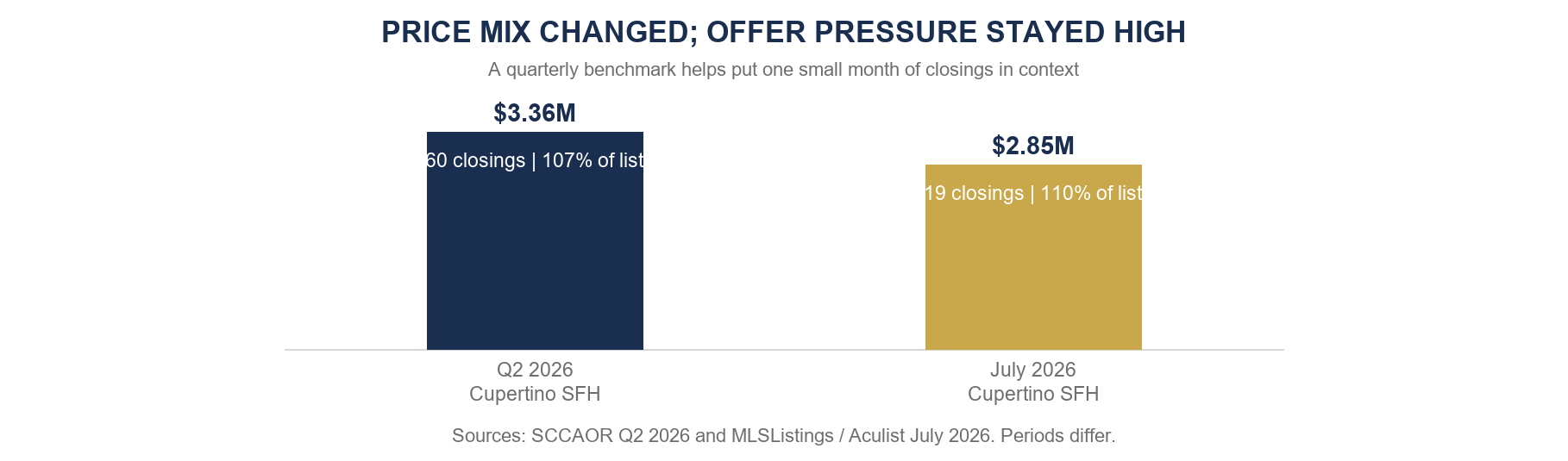
Cupertino is still highly competitive, but the headline median is not telling the whole story. July's single-family median was $2.85 million, down 18% year over year. The broader second quarter, however, recorded a $3.363 million median across 60 Cupertino single-family closings. With only 19 closings in July, a small change in the size, condition, or school assignment of the homes sold can move the monthly median sharply.
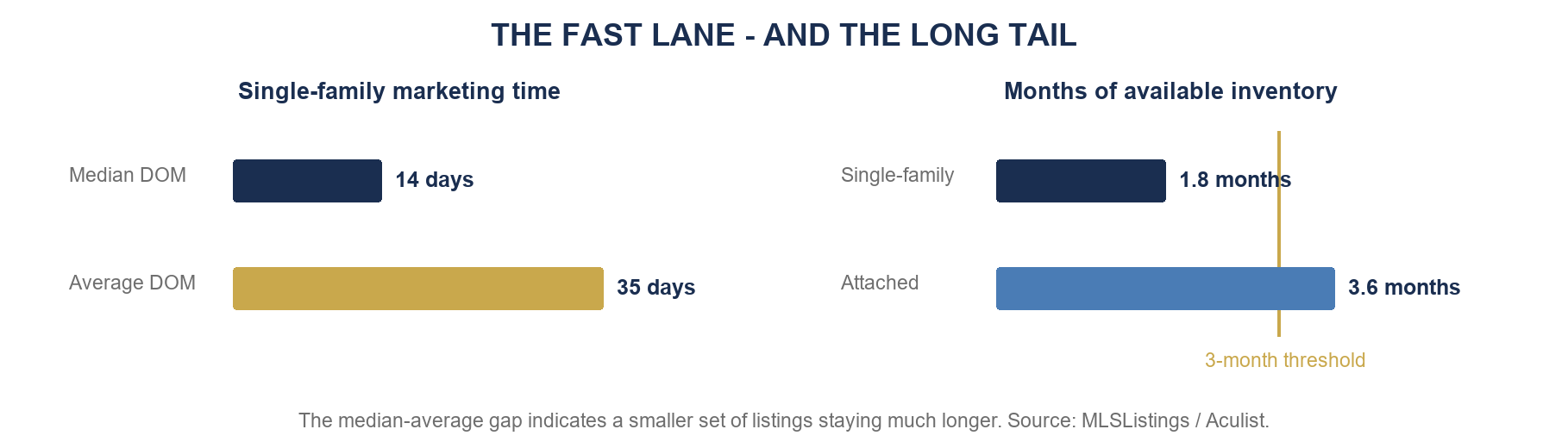
The clearest signal is speed and scarcity. Single-family homes sold in a median of 14 days at 110% of list price with only 1.8 months of inventory. Yet the average marketing time was 35 days. In plain language: the homes that match buyer expectations are moving quickly, while a smaller group of mispriced or compromised listings is staying on the market much longer.
What this means:
- Homeowners and sellers: value must be established at the neighborhood, school-boundary, property-type, and condition level - not from Cupertino's citywide median.
- Buyers: competition remains intense for turnkey single-family homes, but stale listings and the attached-home market offer more room to negotiate.
- Tim & Faye
|
|

|

|
|
Cupertino Market
The Local Pulse
|
|
July 2026 at a glance
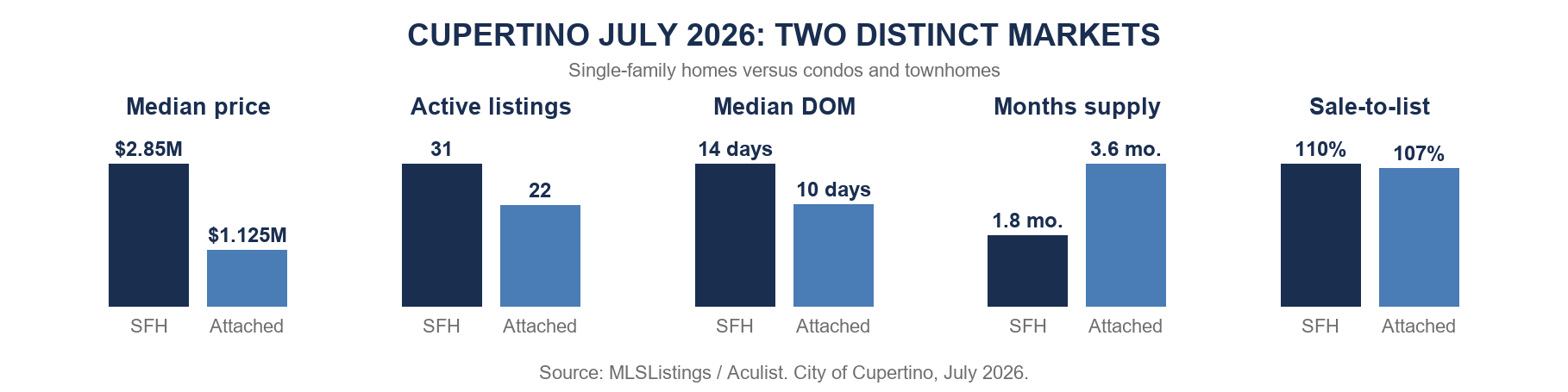
- Single-family: $2.85M median, 19 closed sales, 14 median days, 110% sale-to-list, and 1.8 months of inventory.
- Condos and townhomes: $1.125M median, 6 closed sales, 10 median days, 107% sale-to-list, and 3.6 months of inventory.
- Quarterly context: SCCAOR reported a $3.363M Cupertino single-family median across 60 second-quarter closings, with 107% of list price received. July's smaller 19-sale sample reached 110% of list despite its lower median.
- Financing: the national 30-year fixed average was 6.71% on September 3. At that rate, 20% down on July's $2.85M single-family median implies roughly $15,020 per month in principal and interest before taxes, insurance, and other costs. Jumbo pricing can differ.
|
|
Financing & Affordability
What the September Rate Picture Means
|
|
Freddie Mac's national 30-year fixed average was 6.71% on September 3. With 20% down on Cupertino's July $2.85 million single-family median, the illustrative principal-and-interest payment is about $15,020 per month, before property tax, insurance or other obligations. This is a planning illustration rather than a loan quote; jumbo pricing, points and borrower profiles can differ materially.
C.A.R.'s second-quarter affordability index found that 22% of Santa Clara County households could afford the county's $2.05 million median single-family home. Its model required about $510,800 in annual income at a 6.54% effective rate. Cupertino's own median was higher, so equity, liquidity and loan structure are even more central to the buyer pool.
Many buyers are using adjustable-rate mortgages or temporary buydowns to reduce the initial payment while preserving the opportunity to refinance if fixed rates improve. For a buyer with strong liquidity, expected income growth or a defined holding period, that can be a practical way to enter the market. The adjustment schedule, rate caps and future payment range should be compared with a fixed-rate option before offer day.
For sellers, a targeted financing credit can sometimes address a qualified buyer's payment concern more efficiently than a broad price reduction. For buyers, attached homes may materially lower the loan amount, but HOA dues, reserves, insurance and assessments belong in the same monthly-cost comparison.
|
|
Market Behavior
What Is Moving
|
|
Turnkey single-family homes in the first two weeks. A 14-day median and 110% sale-to-list ratio show that buyers are still rewarding homes that are well prepared, easy to understand, and priced to create competition. Strong school assignments, practical floor plans, updated systems, and clean presentation reduce the number of objections a buyer must absorb at an already high payment.
Homes with credible value at the opening price. Cupertino buyers are analytical. An intentionally competitive list price can produce multiple offers, but a price that depends on an exceptional comparable without matching its location, lot, condition, or school assignment can lose momentum quickly.
Attached homes with a clear ownership proposition. Condos and townhomes closed quickly in July, particularly where the HOA is well funded, the layout feels house-like, parking is simple, and the location offers an obvious commute or school benefit. They remain the principal lower-cost ownership path into Cupertino.
|
|
Market Behavior
Where Activity Stalls
|
|
The gap between 14 median days and 35 average days is the warning light. It suggests that most homes either connect quickly or join a much slower tail. The usual causes are not simply "the market": they are an ambitious starting price, functional compromises, deferred maintenance, difficult access, or a mismatch between the home and the buyer pool implied by its price.
Attached inventory is less scarce. At 3.6 months of supply, buyers have more alternatives than the 10-day median alone suggests. That creates leverage on older listings and makes HOA financial health, insurance, reserves, and pending assessments central to value.
A stale listing needs a strategy reset, not cosmetic price trimming. Once a home passes the initial 14-to-21-day decision window, the seller should reassess price, presentation, access, and buyer feedback together. Repeated small reductions can advertise uncertainty without creating a genuinely new value proposition.
|
|
Regional Comparison
AI Wealth: Relevant, Not the Whole Story
|
|
Independent reporting from WIRED and The Guardian describes AI-company equity and tender-offer proceeds beginning to influence the upper end of San Francisco housing. WIRED documented several unusual Bay Area listings that invited consideration of Anthropic or OpenAI shares. That is striking evidence of paper wealth and liquidity expectations, but it is not a broad housing-price index.
Cupertino may benefit indirectly, but its demand base is broader and different. Apple and established South Bay technology wealth, school-driven moves, existing-home equity, and very limited single-family supply remain the core supports. AI liquidity could add buyers at the premium end, especially when families compare Cupertino's space and schools with Peninsula alternatives, but the current evidence does not justify applying San Francisco's exceptional story uniformly to Cupertino.
| |
Our read: AI money is most likely to reinforce Cupertino's strongest segment - distinctive, well-located single-family homes - before it lifts every property type evenly. The city can remain highly competitive while individual listings still stagnate. |
|
|
What Changes Next
The Forces to Watch
|
|
The Rise at the former Vallco site. Cupertino approved a 2026 modification retaining 2,669 planned homes. The developer's Town Square West phase describes 1,369 homes, including 393 for-sale homes, 744 market-rate rentals, and 232 affordable rentals, plus retail and park space. This is a multi-year change, not immediate resale inventory; its first-order effect may be stronger amenities and a new housing option, followed later by more competition for attached and newer-product buyers.
School enrollment and assignment. Fremont Union projects district attendance of 9,117 in 2026-27, down 56 students for the year, with Cupertino High projected down 45 and Monta Vista nearly flat. Five-year projections then rise at both Cupertino and Monta Vista. Enrollment shifts do not erase school demand, but owners and buyers should verify assignments directly with the districts and watch future policy changes instead of relying on listing portals.
Mortgage rates and equity markets. At Cupertino price points, conventional national averages are only a reference because many buyers use jumbo loans, ARMs, larger down payments, stock compensation, or proceeds from a prior home. Still, the September 3 average of 6.71% keeps payment and liquidity planning central to the offer strategy.
|
|
Six-Month Outlook
Our Base-Case View
|
| Segment |
Expected direction |
Why |
| Turnkey SFH |
Competitive |
Low supply, school demand, and equity-rich buyers. |
| Dated or stale SFH |
Negotiable |
Buyers are selective and financing magnifies repair costs. |
| Attached homes |
Mixed |
More supply creates choice; best units still move quickly. |
| Headline median |
Volatile |
Small monthly closing counts make mix shifts look like market shifts. |
|
|
Prediction: through the fall and into early 2027, Cupertino is more likely to remain a two-speed market than move uniformly up or down. Seasonal cooling should reduce the number of bidders, but single-family inventory below two months is likely to protect well-positioned homes. Price measurements will remain noisy unless transaction volume rises.
This is a market outlook, not a guarantee of future value. Property condition, micro-location, school assignment, lot, architecture, and financing can materially change an individual result.
|
|
Recommendations
What Matters Now
|
|
For Cupertino homeowners:
- Use a micro-market valuation. Separate single-family from attached and confirm the actual school assignment.
- If considering a sale, measure the move against your current mortgage, tax basis, and replacement-home cost before assuming today's price alone makes the decision.
- Track The Rise as a long-term neighborhood and product-mix change, especially if you own an attached home nearby.
For sellers:
- Treat the first 14 days as the primary market test; inspections, repairs, staging, photography, and access should be ready before launch.
- Price from the subject home's buyer pool, not from the highest nearby sale.
- If response is weak after the first two weekends, change the value proposition decisively.
For buyers:
- For a turnkey single-family home, prepare the price range, underwriting, and risk limits before offer day.
- Look beyond fresh listings: a home past 21 days may offer the best negotiation window if its compromises are acceptable.
- For condos and townhomes, review HOA reserves, insurance, special assessments, litigation, and rental restrictions before treating the lower price as the full affordability story.
|

All information is deemed reliable but not guaranteed. This is a general market analysis, not an appraisal, financial advice, tax advice, or legal advice.
TIM ALFORD DRE #01507448 · FAYE BON DRE #01746037 · SERENO GROUP, INC. DRE #02101181
Sources: MLSListings / Aculist, Cupertino July 2026; Santa Clara County Association of REALTORS, July 2026; Santa Clara County Association of REALTORS, Q2 2026; C.A.R., Q2 2026 Housing Affordability; BLS, San Jose metro July 2026 employment; WIRED, AI Equity and Bay Area Housing; The Guardian, AI Wealth and San Francisco Housing; City of Cupertino - The Rise; Fremont Union High School District Enrollment Projections; Freddie Mac PMMS, September 3, 2026.
SCCAOR had not published August 2026 city statistics as of September 5, so July remains the newest complete official city period for this edition. Data windows and property-type definitions vary by source. Predictions are informed opinions based on current conditions and may change. |
|